





Based on the MICROTRAC application note "The BET Method for Microporous Materials". Audience: scientists, lab managers, QC and R&D professionals working with activated carbon.
What Is the BET Surface Area of Activated Carbon?
The BET surface area of activated carbon is its specific surface area in m2/g, calculated from a gas adsorption isotherm with the Brunauer–Emmett–Teller (BET) method. Typical values are 500 - 1,500 m2/g, and highly activated grades exceed 2,500 m2/g. The exact value depends on the raw material, such as coconut shell, coal or wood, and on the activation process.
Activated carbon is microporous and gives a type I isotherm. The BET surface area of activated carbon must therefore be evaluated with the Rouquerol criteria and not with the standard IUPAC relative pressure range p/p0 0.05 - 0.30, because the standard range overestimates the value.
| 参数 | 值 | Note |
|---|---|---|
| Typical BET surface area of activated carbon | 500 - 1,500 m2/g | Depends on raw material and activation process |
| BET surface area of highly activated grades | Above 2,500 m2/g | — |
| Isotherm type of activated carbon | Type I | Microporous material |
| Standard IUPAC BET range | p/p0 0.05 - 0.30 | Not valid for activated carbon |
| Valid BET range for activated carbon | Set by the Rouquerol criteria | Example in Figure 1: p/p0 ≤ 0.0825, 1,370 m2/g |
| Governing standard | ISO 9277 | BET specific surface area by gas Adsorption |
Key facts of BET surface area measurement of activated carbon.
Why the BET Surface Area Matters for Activated Carbon
Measuring the BET surface area of activated carbon is essential for quality control, for comparing feedstocks and activation methods, and for predicting service life. The performance of activated carbon is governed by its internal surface area and pore structure: the larger the accessible surface and the better the pore size matches the target molecule, the higher the adsorption capacity.
Activated carbon is one of the most widely used industrial adsorbents. The same BET measurement underpins water and wastewater treatment, air and gas purification (VOC control), solvent recovery, catalyst supports, energy storage in supercapacitor electrodes, and purification in pharmaceuticals and food. In each application the pore structure must match the target species.
| Pore Class | Pore Width | Role for Activated Carbon |
|---|---|---|
| Micropores | Below 2 nm | Adsorption of small molecules and ions; govern the performance of activated carbon |
| Mesopores | 2 - 50 nm | Adsorption of larger species |
| Macropores | Above 50 nm | Transport pores; characterized by mercury intrusion |
Pore classes of activated carbon and their role in adsorption.
Why Is Standard BET Analysis Challenging for Activated Carbon?
Standard BET analysis is challenging for activated carbon because activated carbon is microporous and produces a type I isotherm, while the BET method is strictly applicable to type II and type IV isotherms. Micropore filling interferes with the isotherm in the standard IUPAC range p/p0 0.05 - 0.30, so a BET fit over that range does not represent the true surface area.
The Brunauer–Emmett–Teller (BET) method is the most common method for evaluating specific surface area, and IUPAC recommends evaluation at p/p0 = 0.05 - 0.30, where monolayer completion occurs. Applying the BET method correctly to activated carbon requires a validated, material-specific pressure range.
| Isotherm Type | Example Material | BET Relative Pressure Range |
|---|---|---|
| Type II | Nonporous quartz sand | Standard IUPAC range p/p0 0.05 - 0.30 |
| Type IV | Mesoporous Develosil porous silica | Standard IUPAC range p/p0 0.05 - 0.30 |
| Type I | Microporous activated carbon | Range validated with the Rouquerol criteria |
BET relative pressure range by isotherm type.
Rouquerol Criteria for the BET Analysis of Activated Carbon
The Rouquerol criteria extend the BET method to type I isotherms by validating the relative pressure range used for the BET fit. Three conditions apply: the BET constant C must be positive, n(1 − p/p0) must increase continually with p/p₀ within the range, and the p/p₀ value at monolayer capacity must lie within the range.
| Criterion | Requirement for the Selected p/p0 Range |
|---|---|
| 1 | The BET constant C is positive |
| 2 | The range is limited to the region where n(1 − p/p0) increases continually with p/p0 (n = adsorbed amount) |
| 3 | The p/p0 value corresponding to the monolayer capacity falls within the selected range |
Rouquerol criteria (Rouquerol et al.) for BET analysis of type I isotherms.
The Rouquerol plot applies the criteria in practice. The maximum of the Rouquerol plot marks the upper limit of the acceptable p/p₀ range, and relative pressures beyond this point must not be used. For the activated carbon in Figure 1, the valid range is p/p0 ≤ 0.0825, giving a BET surface area of 1,370 m2/g with C = 2,128 and R2 = 0.9998.
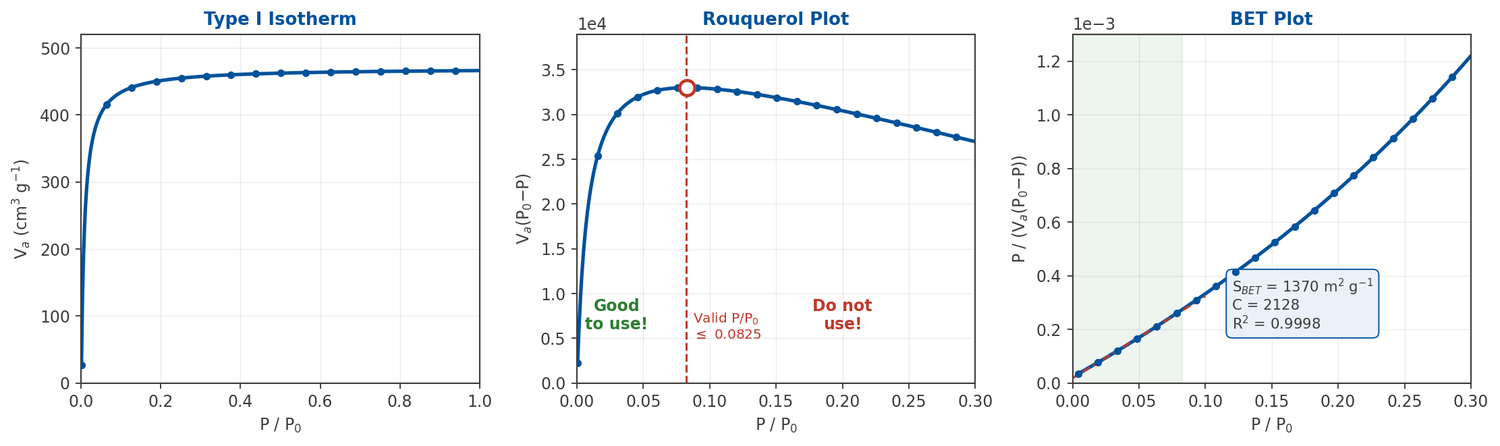
Figure 1: Type I isotherm, Rouquerol plot and BET plot of activated carbon. Valid range p/p0 ≤ 0.0825; BET surface area 1,370 m2/g, C = 2,128, R2 = 0.9998.
Automatic Rouquerol Evaluation in MICROTRAC's BELMASTER7 Software
MICROTRAC's BELMASTER7 software determines the upper p/p0 limit of the BET range automatically when the type I (ISO 9277) setting is selected. The valid BET range is highlighted in a contrasting color, so users obtain a BET range that follows the Rouquerol criteria and ISO 9277 without selecting the range manually.
In the BELMASTER7 software, select the isotherm, then Analysis → BET plot → Settings → Analysis parameter settings → Type I (ISO 9277) → OK. The Rouquerol criteria give a reliable BET range and avoid the overestimation of the BET surface area caused by invalid data points.
BET Compared With Mercury Intrusion, Iodine Number and Methylene Blue for Activated Carbon
BET gas adsorption is the reference method for activated carbon because BET gas adsorption covers the micropores that govern performance. Mercury intrusion, iodine number and methylene blue probe different parts of the pore network and are complementary, not interchangeable: mercury intrusion covers macropores, iodine number screens micropore capacity, and methylene blue covers larger molecules.
| 方法 | What the Method Measures | Pore Range | Unit / Standard | Role for Activated Carbon |
|---|---|---|---|---|
| BET (gas adsorption) | Total internal surface area | Micropores and mesopores | m2/g, ISO 9277 | Reference: micropore surface that defines performance |
| Mercury intrusion (BELPORE) | Pore volume and size of macropores and large mesopores | From approx. 3.5 nm to approx. 500 µm | ISO 15901-1 | Complementary: transport pores, not micropores |
| Iodine number | Micropore adsorption capacity | Micropores below approx. 2 nm | mg/g, ASTM D4607 | Fast QC proxy, not a true surface area |
| Methylene blue | Adsorption of larger molecules | Mesopores above approx. 1.5 nm | mg/g | Supplementary |
Methods for characterizing activated carbon and the pore ranges they probe.
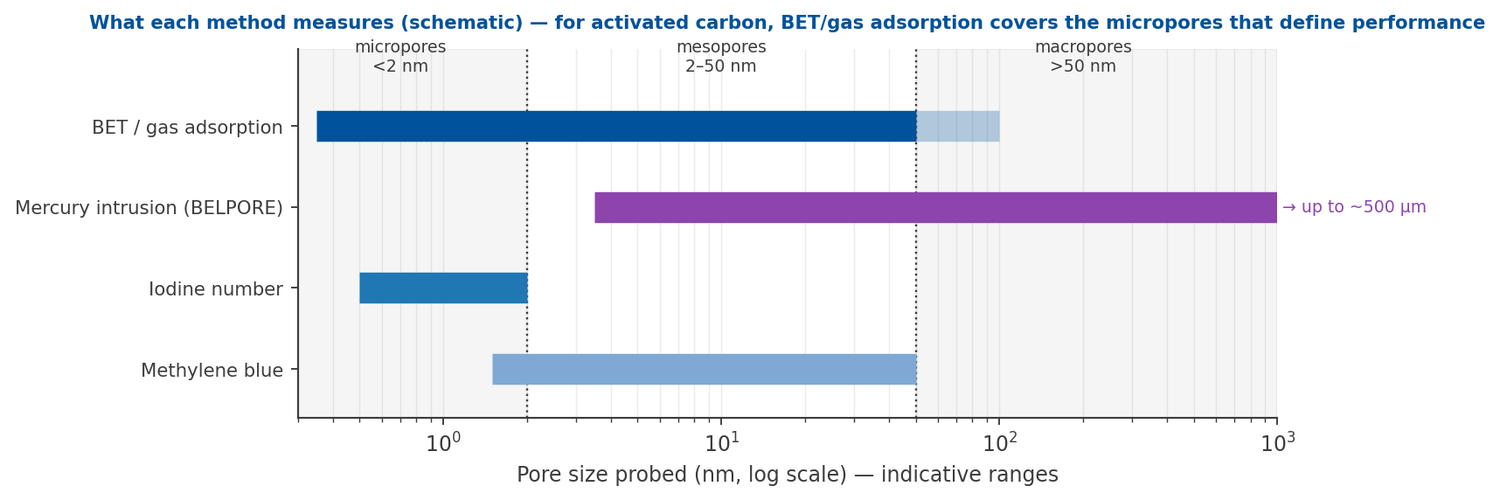
Figure 2: Indicative pore size ranges probed by each method (schematic). BET gas adsorption covers the micropores of activated carbon; mercury intrusion extends from approx. 3.5 nm into the macropore range, up to approx. 500 µm.
Should I Use BET Surface Area or Iodine Number for Activated Carbon?
Use the iodine number (ASTM D4607) for quick screening of micropore capacity in mg/g, and use the BET surface area (ISO 9277) for complete, validated characterization in m2/g. The iodine number is a fast field and QC test and not a true surface area, whereas BET gas adsorption gives a standardized surface area and pore structure profile.
An iodine number of about 1,000 mg/g is often associated with a BET surface area of roughly 900 - 1,100 m2/g. The correlation is only approximate: it holds mainly for microporous carbons below ~1,000 m2/g, with iodine values usually within ~10% of the BET value, and it breaks down for mesoporous carbons. Treat iodine number as a quick proxy, not a substitute for BET.
How Is the Micropore Volume of Activated Carbon Measured?
The micropore volume of activated carbon is calculated from a nitrogen or argon adsorption isotherm with the t-plot method, the Dubinin–Radushkevich method (DIN 66135-3) or the Horvath–Kawazoe and Saito–Foley methods (DIN 66135-4). The t-plot method also separates the micropore surface area from the external surface area.
| 方法 | 标准 | Result for Activated Carbon |
|---|---|---|
| T-plot method | ISO 15901-3, ASTM D4365 | Micropore volume; micropore surface area separated from external surface area |
| Dubinin–Radushkevich method | DIN 66135-3 | Micropore volume |
| Horvath–Kawazoe and Saito–Foley methods | DIN 66135-4 | Micropore volume |
Methods for the micropore volume of activated carbon.
Standards for the Surface Area and Micropore Analysis of Activated Carbon
ISO 9277 governs the BET surface area by gas adsorption, ISO 15901-3 and DIN 66135 cover micropore analysis by gas adsorption, and ASTM D4607 covers the iodine number of activated carbon. ISO 15901-1 covers mercury intrusion, and ASTM D4365 covers micropore volume and zeolite area of a catalyst. Standard methods validate industrial processes.
| 标准 | 范围 | 测量原理 | Related Result |
|---|---|---|---|
| ISO 9277 | Specific surface area of solids by gas adsorption, BET method | 气体吸附 | BET surface area (m2/g) |
| ISO 15901-3 | Analysis of micropores by gas adsorption (Part 3) | 气体吸附 | Micropore analysis |
| DIN 66135-1 to -4 | Micropore analysis by gas adsorption: basics, isotherm comparison, Dubinin–Radushkevich (Part 3), Horvath–Kawazoe and Saito–Foley (Part 4) | 气体吸附 | Micropore volume |
| ASTM D4365 | Micropore volume and zeolite area of a catalyst | 气体吸附 | Micropore volume |
| ISO 15901-1 | Pore size distribution by mercury intrusion | Mercury intrusion | Macropore and large mesopore volume |
| ASTM D4607 | Iodine number of activated carbon (industry QC) | Wet-chemical adsorption test | Iodine number (mg/g) |
{{LL::knowledgebase.bet-activated-carbon.standards-surface-area.table.caption]]
In catalysts, catalyst supports and zeolites, the accessible micropore and mesopore network is largely developed during high-temperature calcination and template removal. The t-plot method then quantifies the resulting micropore surface area and micropore volume.
The same micropore and surface area analysis is applied to battery and supercapacitor materials such as hard carbons, graphite and activated carbons, where the pore structure controls ion accessibility and rate performance.
Complementary Tests and Sample Preparation for Activated Carbon
Ash content, carbon and sulfur content, and a homogeneous sub-sample complement BET analysis of activated carbon. CARBOLITE ashing furnaces determine ash content by combustion, ELTRA carbon/sulfur analyzers determine carbon and sulfur content by combustion analysis, and RETSCH milling and sieving solutions prepare a representative sample.
Ash Content Determination of Activated Carbon
The ash content of activated carbon, a routine quality parameter beyond surface area, is determined by combustion in an ashing furnace. Carbolite ashing furnaces provide this high-temperature heating, and Carbolite high-temperature furnaces are also used for the thermal activation and regeneration of activated carbon.
Carbon and Sulfur Analysis of Activated Carbon
The carbon and sulfur content of activated carbon is determined by combustion analysis. Eltra carbon/sulfur analyzers burn the sample in an oxygen stream and detect the released carbon and sulfur gases, so the elemental composition completes the picture next to the BET surface area.
Sample Preparation of Activated Carbon for BET Analysis
{{LL::knowledgebase.bet-activated-carbon.sample-prep.txt]]
| 标准 | 范围 | Related Method |
|---|---|---|
| ISO 9277 | Determination of the specific surface area of solids by gas adsorption (BET) | BET analysis |
| ISO 15901-3 | Analysis of micropores by gas adsorption | T-plot method |
| ASTM D4365 | Determining micropore volume and zeolite area of a catalyst | T-plot method |
Standards related to t-plot analysis.
Suitability of BET Analysis With the Rouquerol Criteria for Activated Carbon
BET analysis with the Rouquerol criteria suits QC and R&D laboratories that need a validated BET surface area of microporous activated carbon with a type I isotherm. BET analysis with the Rouquerol criteria does not suit the characterization of macropores and transport pores, which needs mercury intrusion, or quick screening, which the iodine number covers.
| BET Analysis With the Rouquerol Criteria Suits | BET Analysis With the Rouquerol Criteria Does Not Suit |
|---|---|
| QC laboratories that compare feedstocks and activation methods of activated carbon | Macropore and transport pore characterization; mercury intrusion with the Microtrac BELPORE is the corresponding method |
| R&D laboratories that need a validated BET surface area, micropore volume or pore size distribution of microporous activated carbon | Quick field screening of micropore capacity; the iodine number (ASTM D4607) is the corresponding test |
| Laboratories that need results in line with ISO 9277 | Materials with type II or type IV isotherms, which use the standard IUPAC range p/p0 0.05–0.30 |
Fit of BET analysis with the Rouquerol criteria by laboratory task.
MICROTRAC Instruments for the BET Surface Area Analysis of Activated Carbon
MICROTRAC gas adsorption analyzers collect isotherms on activated carbon, and MICROTRAC's BELMASTER7 software applies the Rouquerol criteria automatically. The range comprises the BELSORP MAX X, BELSORP MINI X and BELSORP MR-1 for gas adsorption and the BELPORE for mercury intrusion porosimetry.
| 仪器 | 功能介绍 | Key Specifications |
|---|---|---|
| BELSORP MAX X | Micropore and high-resolution surface area and pore analysis | Relative pressure P/P0 from ~1×10⁻⁸ to 0.997 (N2 at 77.4 K / Ar at 87.3 K); up to 4 samples measured simultaneously (4 independent ports plus a dedicated saturation-pressure port). Pore size range 0.35 - 500 nm. |
| BELSORP MINI X | Surface area and pore size distribution analysis | Low-pressure isotherm from P/P0 = 1×10⁻⁴ (N2 77 K / Ar 87 K); up to 4 samples measured simultaneously (3- and 4-port models; 3 ports in High-Accuracy mode) plus a dedicated saturation-pressure port. Pore size range 0.7–500 nm (0.35 nm optional). |
| BELSORP MR1 | Routine BET surface area analysis for quality control | Dynamic-flow single-point BET; one sample per run; surface-area range 0.01 m2/g and above; ~15 min per measurement. As a flow method, it does not use a static relative-pressure range or multiple analysis ports. |
| BELPORE | Mercury intrusion porosimetry for macropore and large mesopore analysis | Pressure range: low-pressure from vacuum to 450 kPa; high-pressure up to 228 MPa (MP model) or 414 MPa (HP model), covering pore diameters from ~180 µm down to ~0.0036 µm (≈3.6 nm). |
MICROTRAC instruments for the surface area and pore analysis of activated carbon.
Related MICROTRAC Knowledge Base Articles on BET Analysis
The MICROTRAC knowledge base explains BET theory, specific surface area, pore size distribution and the t-plot method in detail. Each article covers one topic of the BET cluster, from the BET equation to the separation of micropore surface area from external surface area.
| Article | Content |
|---|---|
| BET理论 | How the BET equation derives specific surface area from a gas adsorption isotherm |
| 比表面 | What specific surface area is and why specific surface area governs adsorption performance |
| Pore size distribution | How micropores, mesopores and macropores are measured and expressed |
| Mesopore and macropore Analysis | Analysis of mesopores and macropores |
| T-plot method | How the t-plot separates micropore surface area from external surface area |
MICROTRAC knowledge base articles on BET analysis.
Activated Carbon Measurement by the MICROTRAC Application Laboratory
Send an activated carbon sample to the MICROTRAC Application Laboratory, which measures BET surface area, micropore volume and pore size distribution. To obtain validated BET surface area, micropore volume or pore size data for activated carbon, request a quote or book a demo with a MICROTRAC gas adsorption specialist.




如果您对报价感兴趣或需要更多信息,请联系我们。
了解麦奇克分析仪用于的许多不同应用领域。
More about MICROTRAC'S technology and tried-and-true measurement methods.
Take a look at our application laboratory and measurement service.